next-i18next vs next-intl
A practical breakdown of DX, App Router fit, message format, and scaling. Pick the best option for your Next.js app.
Before we get started...
If you’re building a plain React (CSR) app without Next.js, you should instead read the react-i18next vs react-intl comparison.
This post is a general overview of these libraries, if you want a full walkthrough on setting up next-i18next in a Next.js app, check out this tutorial. If you'd prefer a full next-intl setup guide, check out this tutorial.
Introduction
If you’re building a modern Next.js app, two of the most common internationalization solutions are i18next (typically via react-i18next or next-i18next) and next-intl.
While both libraries solve the same problem, translating content, they take very different philosophical approaches. i18next is a framework-agnostic, highly extensible internationalization engine. next-intl is a Next.js-native solution designed specifically for the App Router era.
Whichever stack you pick, i18nexus helps you centralize strings, keep translators and developers in sync, AI translate strings, and ship updates faster without passing JSON files around.
Philosophy and Scope
i18next is not specific to Next.js. It works across React, Vue, Svelte, Node.js, and more. It provides a powerful core engine with plugins for language detection, backend loading, ICU support, and more.
next-intl, on the other hand, is purpose-built for Next.js, especially the App Router. It embraces React Server Components and focuses on simplicity, type safety, and idiomatic Next.js patterns.
If you want maximum flexibility across platforms, i18next may be appealing. If you're building strictly for Next.js and want tight integration with its routing and server model, next-intl often feels more natural.
Server Components and App Router
next-intl supports both Next.js routing models: the legacy Pages Router and the modern App Router. In practice, it is especially strong in App Router projects because it was designed around server components and modern Next.js patterns.
i18next now has a more direct App Router story too. In March 2026, next-i18next v16 was released with App Router support. Until then, next-i18next was solely a Pages Router solution, and the i18next maintainers recommended using react-i18next directly for App Router projects.
Since that support is brand new, it is fair to expect a few rough edges while things mature. For example, one current annoyance is that updated translation JSON files do not automatically refresh in development without a workaround to avoid needing to restart the server to see updates.
next-intl was designed with React Server Components in mind. It allows translations to be loaded directly in server components without hydration overhead.
That said, the tradeoff is still a little different. next-intl feels more tightly aligned with modern Next.js conventions, while i18next gives you the larger i18next ecosystem, more plugin flexibility, and a path that extends beyond Next.js if you need it.
In short: next-intl still tends to feel more “native” in modern Next.js projects, but next-i18next is now a real App Router option instead of a workaround.
Configuration and Setup in App Router
The examples below are minimal setups for App Router projects.
If you use i18nexus, both approaches become easier to operate in practice because your translations stay in one place and can be pulled automatically into your repo.
Here’s the minimal next-intl App Router setup:
{
  "HomePage": {
    "title": "Hello world!"
  }
}
For a full walkthrough, see our next-intl tutorial.
And here’s a minimal next-i18next App Router setup:
This is much cleaner now than the older custom react-i18next approach many teams were using before next-i18next v16 landed.
Still, this part of the ecosystem is new enough that you should expect a little more setup nuance than with next-intl. A good example is the dev-only i18n.reloadResources() call below, which is currently needed if you want updated translations to show up without restarting the server.
import type { I18nConfig } from 'next-i18next/proxy';

const i18nConfig: I18nConfig = {
  supportedLngs: ['en', 'de'],
  fallbackLng: 'en',
  defaultNS: 'common',
  ns: ['common', 'home'],
  hideDefaultLocale: true,
};

export default i18nConfig;
For a full walkthrough, see our next-i18next App Router tutorial.
i18next offers far more configuration options, backend loading, caching layers, browser detection, and more. next-intl is more focused and opinionated.
Bundle Size
Looking at unpacked package sizes, next-intl is about 390kb.
In a Next.js App Router setup with next-i18next, you are really pulling in all three layers: i18next (about 573kb unpacked), react-i18next (about 891kb unpacked), and next-i18next (about 145kb unpacked).
So the practical takeaway is that next-intl starts lighter, while a full Next.js i18next stack is heavier because it layers multiple libraries together.
Popularity
As of the time of these screenshots (March 3, 2026), next-intl has about 1.8 million weekly downloads on npm. react-i18next has about 8.9 million, and next-i18next has about 494,000.
The screenshots below help explain the trend behind those totals.
next-intl:

next-intl shows the steepest growth curve in this comparison. It has increased almost 4x over the last 12 months, which lines up with broader App Router adoption.
react-i18next:

react-i18next has also grown strongly, roughly doubling in the same period. Its absolute volume is much higher, but a lot of that usage comes from general React apps (including CSR), not just Next.js.
next-i18next:
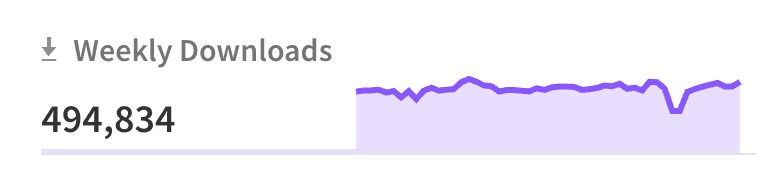
next-i18next appears comparatively flat over the same window. That likely reflects the fact that, until recently, it was still seen mainly as a Pages Router package. With v16 adding App Router support, it will be worth watching whether that trend changes.
Overall, react-i18next is still the most used package by raw downloads, but within the Next.js-specific landscape, next-intl’s growth trajectory is the standout signal.
For teams, the bigger win is usually workflow, not just download charts. i18nexus gives you one translation pipeline no matter which runtime library you choose.
Plural Syntax and Message Format
Let's look at some of the syntax differences in the library.
i18next uses its own interpolation and pluralization syntax by default:
i18next{
"welcome": "Hello {{name}}!",
"notifications_one": "You have one notification.",
"notifications_other": "You have {{count}} notifications."
}next-intl is built around the ICU Message Format, which is a widely adopted standard:
next-intl{
"welcome": "Hello {name}!",
"notifications": "{count, plural,
one {You have one notification.}
other {You have # notifications.}
}"
}If ICU syntax is important to your team, especially if you share translations across multiple platforms, next-intl has an advantage. i18next does support ICU via an add-on, but it is not its default mode of operation.
Context Syntax
Another area where these libraries differ is context handling, especially for gendered or role-based wording.
i18next context{
"invite": "They invited you.",
"invite_male": "He invited you.",
"invite_female": "She invited you."
}
// t('invite') -> 'They invited you.'
// t('invite', {context: 'male'}) -> 'He invited you.'
// t('invite', {context: 'female'}) -> 'She invited you.'In next-intl, context is typically expressed with ICU message selectors, most commonly select (and sometimes selectordinal for ordinal forms):
next-intl context{
"invite": "{gender, select,
male {He invited you.}
female {She invited you.}
other {They invited you.}
}"
}
// t('invite', {gender: 'male'}) -> 'He invited you.'
// t('invite', {gender: 'female'}) -> 'She invited you.'In i18next, this feature is called context. In next-intl, the equivalent behavior is handled with ICU select syntax.
When Should You Choose Each?
Choose i18next if:
- You need cross-framework compatibility.
- You want a mature plugin ecosystem.
- You need advanced language detection or backend loading.
- You want to use the same i18n library outside of Next.js.
Choose next-intl if:
- You are fully committed to Next.js.
- You are using the App Router and Server Components.
- You prefer ICU syntax by default.
- You want a simpler, more opinionated setup.
Wrapping it up
For App Router projects, we still think next-intl has the edge if you want the most Next.js-native experience with the least ambiguity.
But now that next-i18next v16 supports the App Router, i18next is a much stronger option for Next.js than it was before, especially if you already use i18next elsewhere, want its plugin ecosystem, or prefer its overall flexibility.
So the decision is a lot less about “can i18next do App Router?” and more about what kind of developer experience you want: Next.js-native and opinionated with next-intl, or broader ecosystem flexibility with i18next.
The one extra qualifier is that next-i18next App Router support is still fresh. It already looks promising, but you should expect a bit more churn and a few kinks to get worked out compared to the more established next-intl App Router experience.
No matter which library you choose, pairing it with a translation management system like i18nexus can dramatically simplify collaboration, automation, and machine translation workflows.
Level up your localization
It only takes a few minutes to streamline your translations forever.
Get started